Don't miss these three upcoming Energy sessions at GTC.
Accelerating the Transition to a Sustainable Future
Leading energy companies are using NVIDIA technologies to transform the industry and improve quality of life around the world. By pursuing renewable energy sources, building smarter, more resilient grid operations, expediting energy exploration and production, and ensuring safe conditions for workers and communities, they’re helping us move toward a brighter, more sustainable future.

The Conference for the Era of AI and the Metaverse
Developer Conference March 20-23 | Keynote March 21
Earth-2 and Digital Technologies for Net Zero
Learn how Earth-2’s digital twin platform uses Modulus and the Omniverse virtual environment to accelerate technologies that mitigate climate change and its impact. Climate change mitigation is about reducing greenhouse gas (GHG) emissions. The...
How a Software-Defined Smart Grid Powers Energy Reliability and Resiliency
As the edge of the grid becomes exponentially more complex with the adoption of rooftop solar, electric vehicles, home batteries, and dynamic two-way power flow, utilities will need real-time visibility and decentralized decision-making and...
Accelerating the Energy Transition with AI, Simulation, and Industrial Digital Twins
Climate change, combined with geopolitical tensions, demands a faster transition to industrial-scale renewable energy. In order to meet global sustainability targets, a critical need is to quickly design and build larger, more efficient, and...


Extract Value from Data
Turn massive amounts of data from routine upstream operations, pipeline and refinery sensors, and maintenance processes into actionable insights using NVIDIA AI tools.
Supercharge Your Compute
Speed up geophysical and engineering applications with high-performance computing, whether on-premises in your data center or in the cloud.
Protect Health and Environment
Ensure that proper personal protective equipment (PPE) protocols are followed and safety hazards are identified by using AI to observe equipment, predict and detect failures, and save lives.
Streamline Industry Segment Processes
Upstream
Midstream
Downstream
Utilities
Exploration and Production
NVIDIA GPU-accelerated computing platforms have been instrumental in supporting Eni’s exploration activity, improving our ability to turn around advanced seismic imaging tasks in a shorter time and with a higher accuracy.
Seismic Data Processing
Whether you’re using reverse time migration (RTM), Kirchhoff, or full-waveform inversion (FWI) algorithms, seismic processing on NVIDIA GPUs can reduce the time to oil by processing seismic data up to 5X faster than using CPUs alone. By using NVIDIA GPUs, geophysicists processing seismic surveys can apply advanced filters and interpret results on the most complex datasets.
Read how to reduce costs with one-pass reverse time migration >
Geoscience Visualization
Whether you’re using a local workstation or a virtual desktop, NVIDIA professional solutions boost throughput for visualization and heavy computation.
High-performance computing (HPC) and AI improve the calculation of 3D seismic trace attributes and visual analysis of regional basins right at the interpreter’s desk.
Reservoir Simulation
Maximize reservoir performance with the most sophisticated modeling and simulation technology available. NVIDIA GPUs running on CUDA® software speed up and reduce model processing cycle times, allowing researchers to get the most value in the least amount of time.
Watch webinar on advancing the future of energy with high-performance AI >
Health, Safety, and Environment
Protecting employees, contractors, and the environment is the most important job of energy companies today. Leveraging NVIDIA Metropolis, businesses can make their wellsites safer and smarter by applying deep learning to video streams for applications such as employee safety, traffic management, and resource optimization.
Read how Netherlands-based Rolloos uses AI to make oil rigs safer for workers >
Pipeline Optimization
Leverage big data and AI systems to optimize how you fill a pipeline, detect corrosion to identify potential leaks, and automate ultrasonic flow meters to increase throughput. These technologies can also be used to monitor the locations of transports and verify their security.
Other areas include demand forecasting to optimize commodity trading and shipping and pipeline capacity optimization.
Using deep learning and machine learning algorithms, oil and gas companies can determine the best way to optimize their operations as conditions change.
— “NVIDIA and Baker Hughes, a GE Company, Pump AI Into Oil and Gas Industry,” NVIDIA Blog
Predictive Maintenance
Avoid blackouts, downtimes, and unnecessary maintenance costs by identifying discrepancies in machinery in real time and predicting the remaining useful life of equipment. With GPU-based deep learning servers like NVIDIA® DGX™ A100, well operators can visualize and analyze massive volumes of production and sensor data such as pump pressures, flow rates, and temperatures.
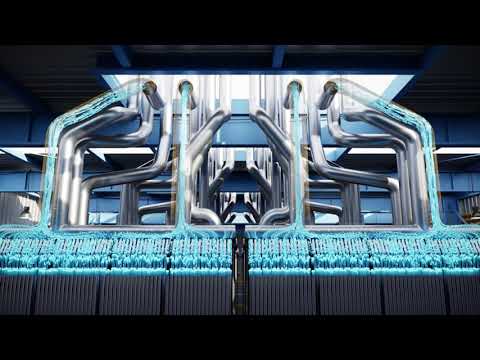
And with NVIDIA Omniverse™ and NVIDIA Modulus, global energy giant Siemens Energy is building a digital twin that could help save $1.7 billion per year in predictive maintenance of heat recovery steam generators.
Other areas of focus include capacity optimization, economic forecasting, and site surveillance.

Performance Optimization
Increase the reliability and performance of your refining assets by identifying the root cause of underperformance, virtual testing operational or asset changes, and minimizing unanticipated risks of proposed changes.
Power Generation and Distribution
Accelerate the transition to a more sustainable future with smart, resilient grids that can forecast demand, generate power, and manage energy resources.
Hydrocarbon
Explore new energy deposits and discover available hydrocarbon reserves with seismic processing. Build accurate models of the subsurface in less time on NVIDIA GPUs.
Renewable
Optimize renewable energy production and cut operational costs, such as wind turbine inspection and maintenance, with AI.
Electricity Retail
Predict future load demand by using advanced metering infrastructure (AMI) data in machine learning models running on NVIDIA GPUs.
Power Grids
Improve the performance of complex grid operations optimization and modeling techniques run on NVIDIA GPUs.
Watch Webinar on Optimizing Power Grids with Dynamic Modeling on NVIDIA GPUs >
GPU-Accelerated Applications for Energy Industry
Our Partners


NVIDIA Solutions for Energy Industries

Computing at the Edge
By collecting and analyzing data at the network’s edge, companies can predict mechanical problems in areas like oil pumps more quickly. Today's industrial edge computing requires GPU-powered compute capabilities for industrial inspection and robotics in factories and predictive maintenance for equipment in the field. The NVIDIA EGX platform provides a single, unifying foundation for industry-leading edge AI applications and frameworks.

Computing in Data Centers
Create efficiencies through high-performance computing, data processing, and data management that support the unique requirements of the industry’s key segments and processes. NVIDIA GPU-accelerated solutions dramatically speed up training of deep learning and machine learning models to deliver insights that were previously not possible. From edge to data center, NVIDIA GPUs are available from every major computer system and server manufacturer. They’re also available in NVIDIA DGX™ Systems, which are equipped with the DGX software stack for rapid deployment, to meet the demands of deep learning and machine learning developers.

Democratize the Data Center with the Cloud
Deliver power from suppliers to consumers using cloud computing to save energy, reduce costs, and increase reliability. NVIDIA GPUs are available on-demand in all major cloud platforms worldwide, and the NGC catalog provides GPU-accelerated containers for easy deployment, including deep learning frameworks such as TensorFlow, PyTorch, MXNet, and more. NVIDIA Metropolis, the application framework for smart cities, is fully integrated with Azure IoT Edge and will soon be integrated with AWS IoT Greengrass.

Accelerate Your Workflows with Software
NVIDIA software libraries and SDKs create a scalable solution that enables customers to deploy inference and AI in the cloud, on their servers, or at the edge. This software investment is designed to accelerate customer time to deployment and reduce overall development costs. NVIDIA software and SDK resources include NVIDIA JetPack™ for embedded applications, DeepStream for intelligent video analytics (IVA), NVIDIA Isaac™ and NVIDIA TensorRT™ for inference, TAO Toolkit for tuning deep neural networks (DNNs), NGC catalog for containers and AI software, and much more.
Learn more about the latest innovations in energy.